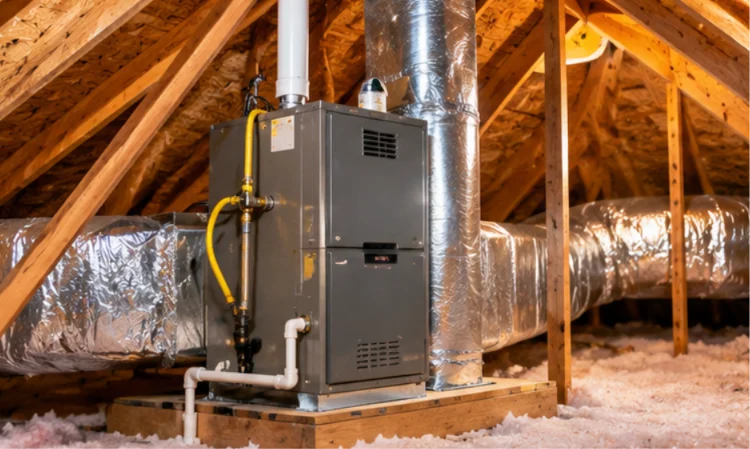
Attic furnaces are standard equipment in many Richardson homes, especially the ranch and two-story houses built during the city's 1960s and 1970s growth. With the furnace out of sight overhead, it is fair to wonder whether burning gas above your bedrooms is a good idea.
Yes. A gas furnace can be safely installed in an attic when the equipment, venting, gas connections, combustion air, drainage, and service access meet code and manufacturer requirements. Important risks include carbon monoxide, gas or venting problems, condensate leaks, and unsafe storage around the equipment.
Yes, an Attic Furnace Is Safe When It Meets Code
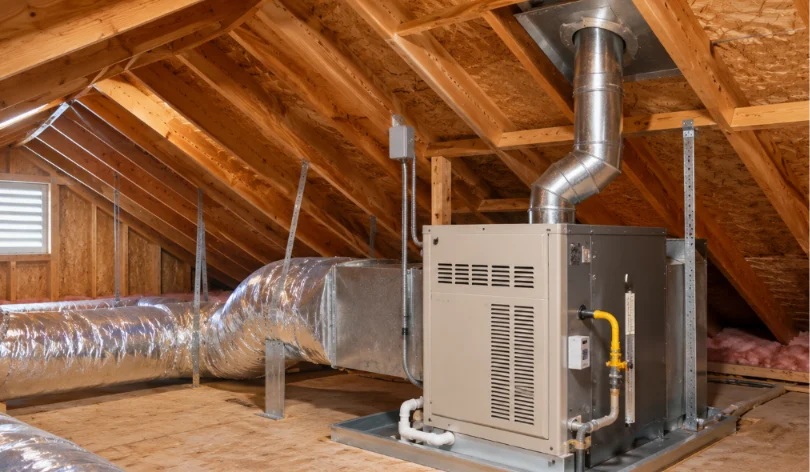
Building codes treat attic furnaces as normal installations with extra rules. Richardson adopted the 2021 International Codes, and the residential code sets requirements for appliances in attics: an access opening large enough to remove the furnace, a floored path to it and a level work space beside it.
Those rules exist so a technician can reach, inspect and service the furnace safely, and so it can be replaced without cutting the ceiling. The code also requires lighting at or near the appliance, controlled from the attic access, along with a receptacle at or near the equipment.
Replacing a furnace in Richardson generally requires a mechanical permit, followed by a city inspection. That inspection is one more check that the new furnace, its gas line and its venting meet current code before it heats your home for the next 15 to 20 years.
Carbon Monoxide Is One of the Main Attic Furnace Safety Concerns
A gas furnace burns fuel in a combustion system that keeps combustion gases separate from the air circulated through the home. Those gases leave through approved venting to the outdoors. A damaged heat exchanger or venting problem can create a risk of combustion gases entering the home, depending on the failure and system conditions.
Carbon monoxide has no color or smell, which is why it is dangerous. The Consumer Product Safety Commission recommends a professional inspection of fuel-burning heating systems and vents every year, plus carbon monoxide alarms on every level of the home and outside sleeping areas.
The 2021 International Residential Code adopted by Richardson includes carbon-monoxide alarm requirements for qualifying homes with fuel-fired appliances. Regardless of when your home was built, CPSC recommends CO alarms on every level and outside sleeping areas. Working alarms add an important layer of protection.
Five Things That Make an Attic Furnace Safe
Most attic furnace problems trace back to a few parts of the installation. When the installation and equipment meet the required safety provisions, an attic is an accepted location for a furnace. Homeowners can keep access and storage areas clear, while a technician should handle combustion, venting, and internal safety checks.
Safe Access and Service Space
A clear, floored path from the attic opening to the furnace, and a level work space beside it, let a technician inspect the burners, vent and heat exchanger properly. Missing flooring or a cramped space often means inspections get skipped or rushed, and problems go unnoticed.
A Sound Vent Pipe
The vent pipe carries exhaust from the furnace through the roof. Joints should be secure, the pipe should slope as the manufacturer requires and nothing should block it. A pipe knocked loose by someone moving boxes in the attic can leak exhaust for months without notice.
A Healthy Heat Exchanger
The heat exchanger helps keep combustion gases separate from the air circulated through the home. Heat exchangers can develop damage from age, repeated overheating, corrosion, or other operating conditions. A confirmed crack or other unsafe heat-exchanger condition requires professional evaluation before the furnace is returned to service.
Overflow Protection Under the Coil
Many attic HVAC systems include an evaporator coil that produces condensate during cooling. Where an overflow could damage the ceiling or other building materials, code requires an approved form of secondary drainage or overflow protection, such as an auxiliary pan, secondary drain, or approved water-level shutoff arrangement. Water in an auxiliary pan signals a drainage problem that should be corrected before it overflows.
Clear Space Around the Furnace
Holiday decorations, suitcases and old furniture often end up beside attic furnaces. The manufacturer's label lists required clearances from combustible materials. Do not use the required service area for storage, and maintain the manufacturer-listed clearances around the furnace and venting.
The takeaway is that an attic furnace is safe when it can be reached, vents properly, has a sound heat exchanger, drains safely and has room to breathe. Each of these can quietly slip over the years, which is why a yearly inspection matters so much.
A Furnace That Still Heats Is Not Proof It Is Safe
Because an attic furnace is out of sight, many homeowners judge it by one test: does the house get warm? If it does, the furnace seems fine, and there is little reason to climb into a hot attic or pay for an inspection when nothing seems wrong.
Here is the trap. A cracked heat exchanger or a loose vent joint can leak exhaust while the furnace still heats perfectly. The house stays warm, but carbon monoxide can build up quietly, and early symptoms such as headaches or nausea are easy to mistake for a winter cold.
That is why the CPSC recommends yearly inspections rather than waiting for a breakdown. A fall furnace maintenance visit checks the burners, heat exchanger, vent and safety controls before the first cold night, when the furnace starts running for hours at a time.
Warning Signs That Your Attic Furnace Needs Attention
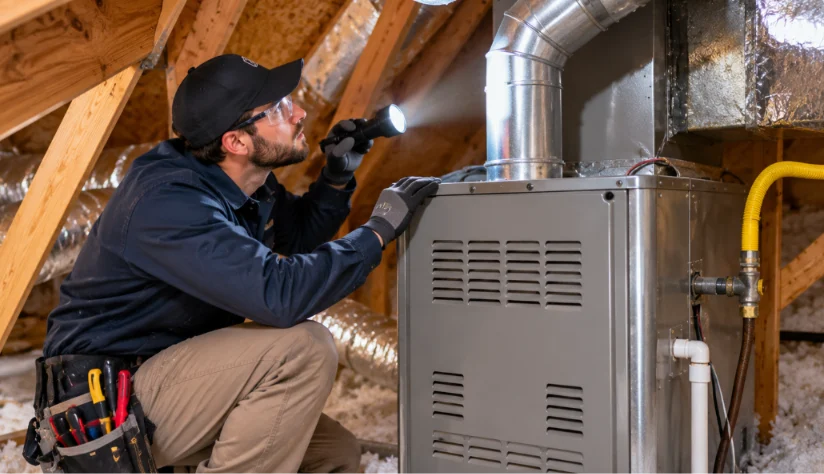
Some attic furnace problems produce warning signs, while others may only be found during an inspection. The table below lists common signs, what they may indicate, and how urgently to act:
| What you notice | What it often means | What to do |
|---|---|---|
| CO alarm sounds | Possible carbon monoxide in the home | Get everyone outside, call 911 |
| Rotten egg smell | Possible gas leak | Leave and call Atmos Energy from outside |
| Visible soot or unusual combustion signs | Possible combustion or venting problem | Turn off the furnace and call for service |
| Soot near the furnace or vent | Venting or combustion problem | Turn off the furnace and call for service |
| Water in the attic drain pan | Condensate drainage or overflow problem | Schedule service soon |
| Headaches that ease when you leave home | Possible carbon monoxide | Get outside and have the furnace checked |
Anything involving gas, carbon monoxide or combustion belongs to a licensed technician, not a homeowner with a flashlight. If a sign on this list shows up, a furnace repair visit can find the cause before it turns into a bigger safety problem.
What to Do If You Smell Gas or the CO Alarm Sounds
Atmos Energy, the gas utility for Richardson, adds an odorant called mercaptan so leaks smell like rotten eggs. If you notice that smell or your carbon monoxide alarm goes off, treat it as an emergency and follow these steps without stopping to search for the source:
- Get everyone out: Leave the house immediately, including pets.
- Do not touch switches: Avoid light switches, thermostats and phones inside.
- Call from outside: Dial 911, and call Atmos Energy's 24-hour emergency line at 866-322-8667.
- Stay out: Wait until emergency crews say it is safe to return.
After emergency crews clear the home, have the furnace inspected before you use it again. A furnace that set off a CO alarm should not run until the cause is found and fixed, even if it seems to work normally afterward.
When an Attic Furnace Should Be Replaced
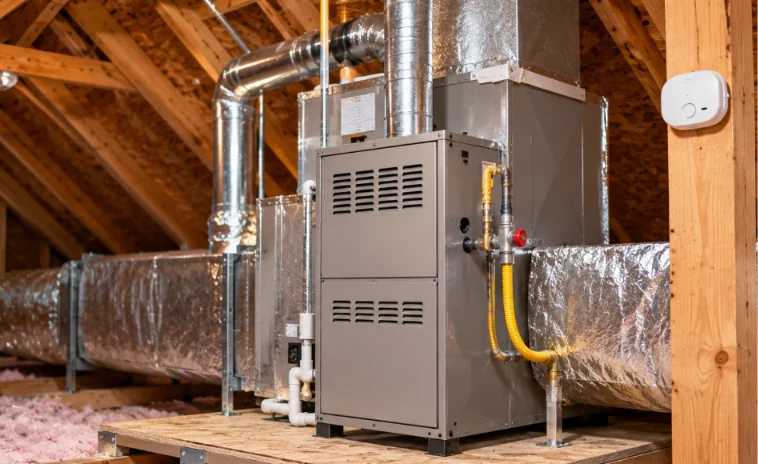
Some attic furnaces are better replaced than repaired. ENERGY STAR suggests considering replacement once a furnace is more than 15 years old. A confirmed heat-exchanger failure on an older furnace can make replacement more practical than a major repair.
Replacement is also a chance to fix attic problems the old installation carried for years, such as poor access, an old vent pipe or a missing drain pan. These situations usually point toward a new furnace rather than another round of repairs on the old one:
- A cracked heat exchanger: The core safety part has failed.
- Repeated repairs: Breakdowns over several recent winters.
- Age past 15 to 20 years: Age increases the likelihood of wear and larger repair decisions.
- A planned AC replacement: The coil and furnace often go together.
A furnace replacement in an attic starts by checking whether a high-efficiency furnace's extra pipe and drain will fit. Homeowners in our Richardson service area can compare options before the old furnace fails, and plan the work for a mild week instead of a cold snap.
How Do You Choose the Right Furnace Contractor for an Attic Installation?
Choose an HVAC contractor who understands the additional safety and installation requirements of attic-mounted gas furnaces. Ask whether they will inspect the venting, combustion air supply, gas connections, condensate drainage, service access, and required safety protections before recommending equipment. A qualified contractor should also explain how the installation will meet manufacturer specifications and local building codes.
Why Choose CityLine Air Conditioning for Attic Furnace Service in Richardson?
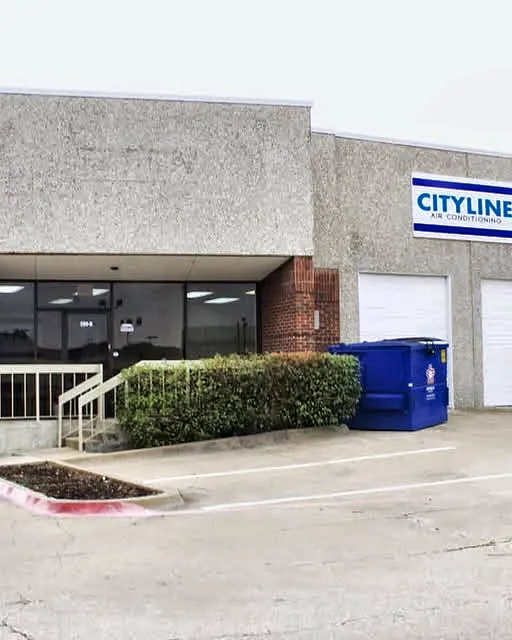
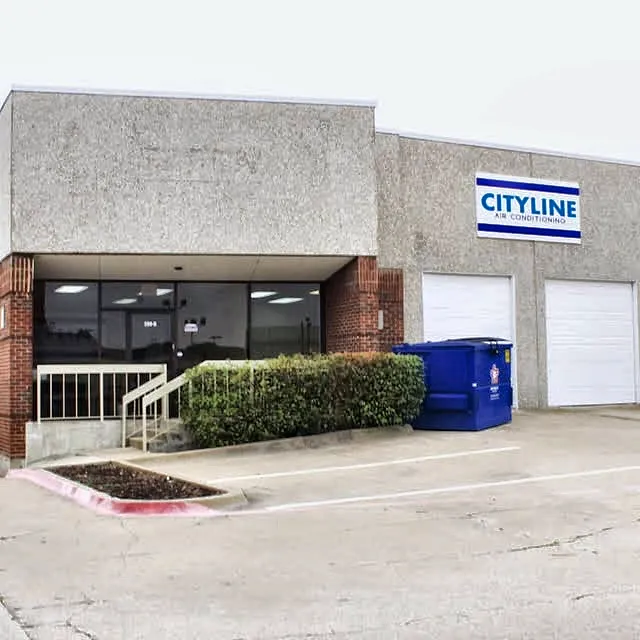
At CityLine Air Conditioning, our office and warehouse sit on South Sherman Street in Richardson, so attic furnaces in local homes are a large part of our work. Our owner, Ed Hafez, holds EPA Section 608 certification, and two of our technicians hold NATE certification.
Our furnace inspection can include the burners, heat exchanger, venting, airflow, and safety controls as appropriate to the system, and we will not put a furnace back into service with an unresolved safety hazard. Our diagnostic is $89 and waived with a same-day repair. We hold Texas license TACLB00033708E.
Our Healthy Air Conditioner Club includes two tune-ups a year, 15% off repairs and no emergency service charge, starting at $189 a year. Our phones are answered around the clock. Call us at (972) 776-4455 to schedule an attic furnace inspection.
Frequently Asked Questions
Is it safe to have a gas furnace in the attic?
Yes. A gas furnace can be safely installed in an attic when the equipment, venting, gas connections, combustion air, drainage, and service access meet code and manufacturer requirements. Working CO alarms and regular professional inspection add important layers of protection.
Do I need a carbon monoxide alarm with an attic furnace?
The 2021 International Residential Code adopted by Richardson includes carbon-monoxide alarm requirements for qualifying homes with fuel-fired appliances. The CPSC also recommends alarms on every level and outside sleeping areas. Test them regularly and replace them according to the manufacturer's instructions.
Can I store things in the attic near my furnace?
Keep the required service area clear and maintain the manufacturer-listed clearances around the furnace and venting. Storage that crowds the equipment can interfere with access and may create safety problems.
How often should an attic furnace be inspected?
Once a year, ideally in the fall before heating season. The CPSC recommends a yearly professional inspection of fuel-burning heating systems and vents. An inspection checks the heat exchanger, burners, vent pipe and safety controls, which matter more in an attic where problems are easy to miss.
What should I do if I smell gas near my attic furnace?
Leave the house immediately and do not touch light switches or the thermostat. From outside, call 911 and Atmos Energy's 24-hour emergency line at 866-322-8667. Do not go back inside until emergency crews say it is safe, and have the furnace inspected before using it.